Blog | News
A New Word in Lighting: A Review of the Alien 150C and 300C Panels from Nanlite
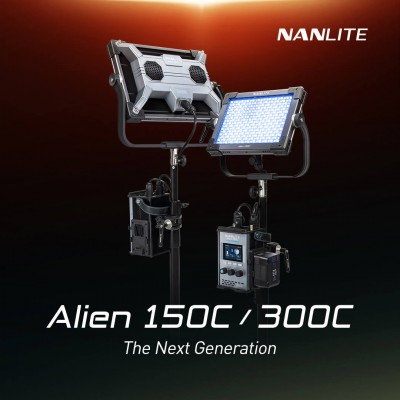
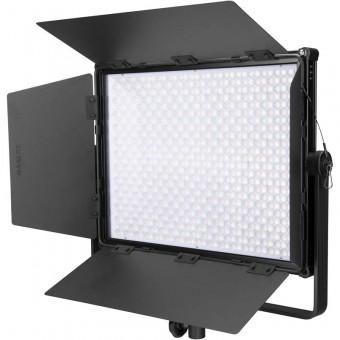
Hello everyone! As a seasoned gaffer, I'm always on the lookout for equipment that not only meets expectations, but exceeds them on set. I recently had the opportunity to test Nanlite's new Alien 150C and Alien 300C panels, and I have to admit, they impressed me. In this review, I will explain why these panels can become indispensable tools for professionals.
Compactness and power: first impressions
The first thing that catches the eye is the lightness and compactness of these panels. The Alien 150C weighs only 3.6 kg, while the Alien 300C weighs 6.6 kg. For devices with such power, this is a more than impressive indicator. They are easily installed on light stands or crane beams, which is very important when you need to quickly change the configuration on the set. Thanks to the division into a head and a control unit, the devices remain mobile and convenient to transport.
Light characteristics: from perfect color rendering to powerful flow
Alien 150C and 300C are not just bright light sources, they are devices that provide high quality color reproduction. With an average CRI of 96 and TLCI of 97, you can be sure that the light will be accurate and natural. This is especially important for shoots where color reproduction plays a key role, be it artistic scenes or shooting on green screen.
But what really impresses is their brightness. At 5600K, the Alien 150C produces 13,050 lux at 1 meter, while the Alien 300C produces 28,630 lux. Even when using a softbox or a diffuser, the light flux remains more than sufficient. This makes these panels an excellent choice for situations where you need to illuminate large spaces or create a powerful key light source.
Flexibility in color adjustment: where and how to apply
One of the main features of these panels is the possibility of flexible color adjustment. With a color temperature range of 2700K to 12000K and adjustable green/magenta tint, these panels allow you to precisely adjust the light for any shooting condition. For example, you can easily simulate the light of a sunset or choose the exact shade to match another light source on the site.
HSI and RGBW modes provide access to 36,000 shades and allow color mixing at the level of individual channels. In real-world work, this means you can create exactly the color you need for a particular scene, whether it's a cinematic effect or simulated neon lighting.
Intuitive interface and management: ease of use
Nanlite took a big step forward with the new interface. It is easy to use and allows you to quickly find the settings you need. The built-in function of saving presets saves a lot of time on setting up, especially if you often work in similar conditions. In addition, the panels support many control methods: from remote control to applications and DMX controllers. This makes them versatile and convenient for integration into complex setups.
Resistance to weather conditions: shooting under any circumstances
Another significant plus of these panels is their resistance to adverse conditions. With an IP55 rating for the head and a special protective cover for the control unit, these panels can easily withstand rain, dust and other extreme conditions. For outdoor shooting, it's a godsend - no need to worry about changing weather or sudden precipitation.
Quiet work: the importance of audio recording
Working with audio on site requires silence, and Nanlite engineers have taken care of that. Thanks to a well-thought-out cooling system with five fan modes, the panels remain virtually silent. In Smart mode, the noise level is only 19 dB(A), which is almost imperceptible to microphones. And in Pause mode, the fans can be turned off completely for a short time while maintaining full brightness, which is especially useful for recording sound in sensitive scenes.
Bottom line: a versatile tool for professionals
The Nanlite Alien 150C and 300C are not just another panel in the lighting market, they are a powerful and versatile tool that can solve many tasks on the set. Regardless of whether you are shooting in the studio or outdoors, these panels will provide you with bright, high-quality and controllable light that will meet all the requirements of modern photography.
If you're looking for a reliable and flexible light source that integrates easily into your projects, the Alien 150C and 300C are definitely worth considering. These panels will help you raise the quality of shooting to a new level, and their functionality and ease of use will save you time and effort.
Flagship Forza Spotlights & Studio LED Panels FAQ
What are the production advantages of the professional «світлодіодна панель» (60W–720W) fixture on set?
The «світлодіодна панель» by Nanlite and leading brands (60W–720W, high illuminance (up to 12,000–65,000+ Lux at 1m with reflector depending on optics)) is built for commercial film sets and broadcast studios, keeping top-end rigging weight low on booms and C-stands while placing controls and V-Mount battery plates within easy reach.
How does «світлодіодна панель» shape light and which modifiers (Bowens S-Type) does it use?
Using Bowens S-Type with 2700K–6500K / 5600K and CRI ≥96 / TLCI ≥97, «світлодіодна панель» delivers either ultra-even diffused illumination or tightly controlled directional output with grids, barn doors, and studio modifiers.
Does «світлодіодна панель» support V-Mount batteries and professional DMX / app control?
Powered via AC 220V / V-Mount Battery, «світлодіодна панель» integrates into multi-light studio setups with remote wireless and DMX/RDM control options across flagship models.
What is the difference between Lux and Lumens, and what is the real brightness of «світлодіодна панель»?
Lumens (lm) measure the total luminous flux emitted by the LED chip in all directions, whereas Lux (lm/m²) measures the actual illuminance hitting your subject at a specific distance (typically 1m) factoring in the reflector or Fresnel lens.
The «світлодіодна панель» (60W–720W) delivers high illuminance (up to 12,000–65,000+ Lux at 1m with reflector depending on optics), ensuring predictable exposure and high contrast control on set.
What do CRI ≥96 / TLCI ≥97 mean on «світлодіодна панель» and why does it matter for skin tones?
CRI (Color Rendering Index) measures color fidelity for the human eye, while TLCI evaluates how accurately a digital camera sensor reproduces those colors without heavy post-production grading.
With CRI ≥96 / TLCI ≥97 and a color temperature of 2700K–6500K / 5600K, «світлодіодна панель» delivers rich R9 red rendering and natural, accurate skin tones straight out of camera.
Related products